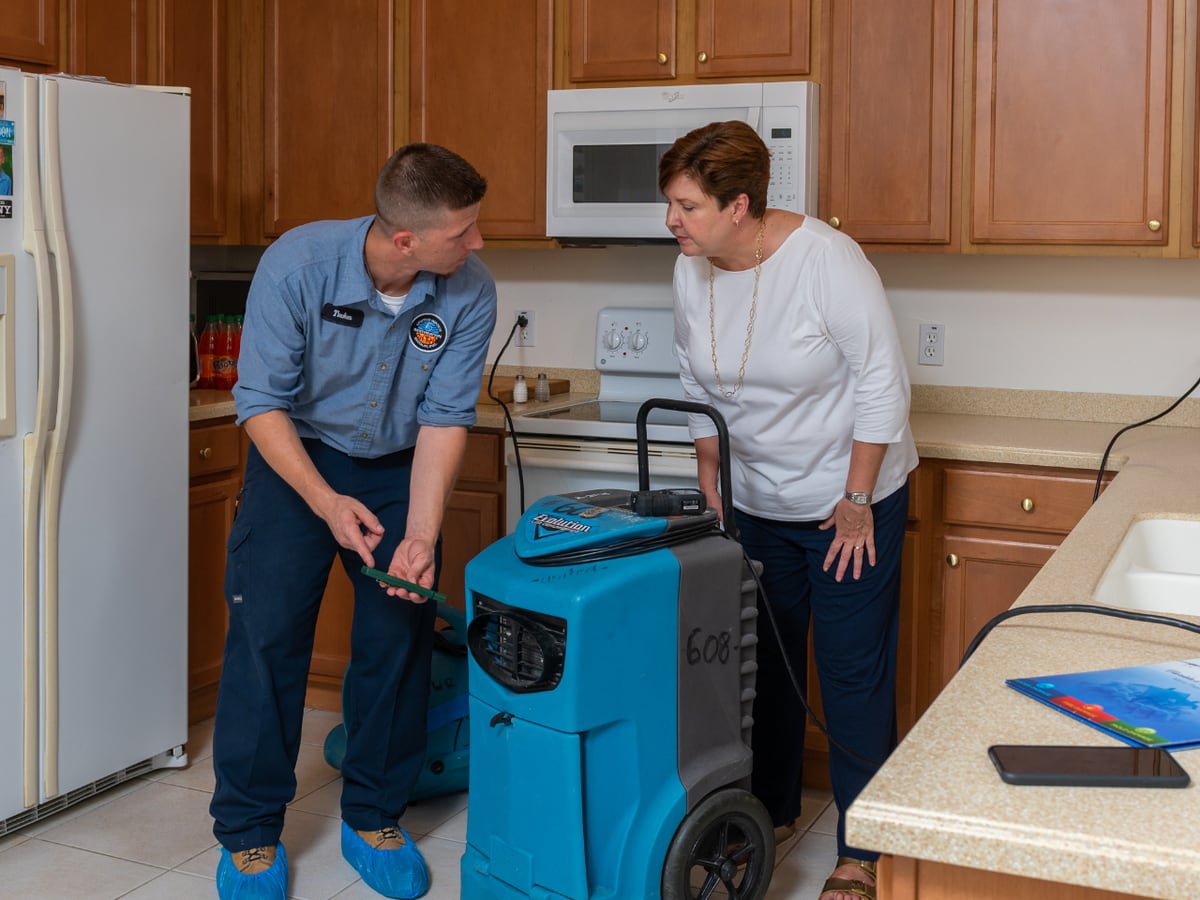
Storm damage in Pinellas County rarely announces itself through a hole you can see from the street. Wind-driven rain gets in at the soffit, saturates attic insulation, and shows up two days later as a sagging ceiling over the living room. That is the job we are called out for most often after a Gulf storm. United Water Restoration Group of Pinellas County works out of 3734 131st Avenue N, Unit #12, Clearwater, FL 33762, in the Gateway area beside St. Pete-Clearwater International Airport. That puts us roughly fifteen to twenty minutes from downtown St. Petersburg down I-275, and about the same from downtown Clearwater by way of Roosevelt Boulevard. Largo and Seminole are a straight run west on Ulmerton. Dunedin and Palm Harbor are a half hour north across the Bayside Bridge. We answer the phone 24/7 at (727) 263-3778, and our rating is 4.93 stars across 169 reviews. We work to IICRC S500 for water damage and IICRC S520 for mold. This page explains what actually happens to a house here during a storm, and what we do about it, in order.
- Certified experts in storm damage cleanup
- Rapid response available 24/7 in Pinellas County
- Comprehensive assessment and restoration
- Assistance with insurance claims and documentation
- State-of-the-art moisture detection and drying technology
The soffit, not the shingles, is how most storm water gets in
Homeowners call and say the roof is fine. From the street it usually is. Sustained winds around 90 mph push rain horizontally into soffit and gable vents, and once it is in the attic it does not need a broken shingle to ruin a ceiling. After Hurricane Charley in 2004, roughly 75 percent of houses assessed for damage had lost soffit material. That single failure mode drives more Pinellas interior storm claims than any other.
What we find in the attic is wet blown-in insulation lying in a heap on top of the drywall. Insulation holds many times its own weight in water. The gypsum underneath softens, the paper facing lets go, and the ceiling either bows or comes down in one piece. Along the way the water tracks down the top plates and into wall cavities, so the damage that looks like a ceiling problem is often a wall problem too.
There is a code history behind this. A 2006 supplement to the Florida Building Code was the first to require soffit systems to resist the same design pressures as windows, a direct response to Charley. Since 86.8 percent of Pinellas housing was built before 2000, the large majority of homes in Largo, Seminole and Pinellas Park have soffits that were never required to meet a wind-pressure standard at all. The median Pinellas home was built in 1976.
So the first thing we do on a storm call is get into the attic with a moisture meter and a thermal camera, not just look at the stain on the ceiling. We map how far the wet insulation runs, check the top plates, and pull back enough drywall to see what is actually wet. Guessing from the stain leaves wet material in the building, and in this climate wet material becomes a mold job.
Tarping and board-up: closing the building before the next band
Tarping is not roofing. It is a temporary cover that buys the building time until a roofer can get to it, and in a peninsula where sea-breeze storms fire almost daily through the wet season, that time matters. The National Weather Service puts the West Central Florida rainy season at May 25 through October 10. A house left open in July, the wettest month at 9.73 inches, gets rained in again before anybody schedules a repair.
A tarp that works is fastened, not draped. We run it over the ridge where the damage is near the peak so water cannot run under the upslope edge, sandwich the edges between furring battens and screws rather than nails alone, and lap seams downhill. We also photograph the roof before and after, because a claim adjuster who arrives ten days later is looking at a blue tarp and needs to know what was under it.
Board-up is the other half. Broken glass on a Gulf-side house in Clearwater or Dunedin is both a security problem and an open door for the next band of rain. We cut plywood to the opening, anchor into the frame or the block, and where the wall is concrete block we use masonry anchors instead of trying to bite into stucco. Pinellas County sits in the windborne debris region, which is why opening protection matters here in the first place; the county building department publishes its own opening protection exception form for one- and two-family dwellings.
We treat this work as the emergency phase, separate from the repair. It is documented separately, it happens the same day where we can get safe roof access, and it is the step that keeps a one-room loss from becoming a whole-house loss. If wind is still up or lightning is in the area, we do interior containment and water extraction first and go up when it is safe.
Helene, then Milton: what a back-to-back sequence does
The 2024 season is the reference point for everyone who works here. Hurricane Helene made landfall near Perry, in the Big Bend, more than 150 miles north of here on September 26. It never came ashore in Pinellas. It still set the all-time record at the Clearwater tide gauge — 6.67 feet above mean higher high water, on a record going back to 1973 — and drove 5 to 7 feet of water above ground level along the entire Pinellas Gulf coast. Twelve people died in the surge in this county alone. Shore Acres, Snell Isle, Coquina Key and Venetian Isles took bay water; Clearwater Beach, Madeira Beach and Indian Rocks Beach took Gulf water. Many of those homes had never flooded before.
Thirteen days later Milton came ashore near Siesta Key as a Category 3. Because it crossed south of Tampa Bay, Pinellas got the reverse: water blew out of the bay, and the damage was wind and rain instead. St. Petersburg recorded 18.87 inches, including 5.09 inches between 8 and 9 p.m. on October 9. The airport logged a 102 mph gust. About 413,000 Pinellas customers lost power, roughly 72 percent of the county.
Between them the two storms damaged 40,910 homes in Pinellas: 28,350 from Helene and 12,560 from Milton. Locals remember the two as one continuous disaster, not two events.
The practical lesson is sequencing. A storm that misses you can flood you, and a second storm can land on a house that is still open and drying from the first. When a system is in the Gulf we prioritize getting equipment out of homes that are mid-dry, re-securing tarps, and getting contents up off slabs. After, we work in the order that limits loss: extraction, emergency cover, then demolition of unsalvageable material, then drying. Rushing straight to rebuilding while the block is still wet is how a job comes back.
Drying a block-and-stucco house on a Pinellas slab
Concrete block with stucco is the dominant wall system for single-family homes on this peninsula, and it changes the drying job completely. Interior drywall is not stuck to the block. It hangs on wood or metal furring strips, which leaves a narrow concealed cavity between the drywall and the masonry. Water runs down into that cavity and sits. A surface moisture meter run along the wall will read dry while there is standing water an inch behind the paper. That is why flood cuts and baseboard removal are standard on block walls here and not optional.
The block itself is a reservoir. It absorbs water and then gives it back to the drywall and the framing for days after the source is fixed. S500 has a name for this kind of work: Class 4, specialty drying of low-permeance, low-porosity materials that hold water tightly — masonry, plaster, hardwood, lightweight concrete. Class 4 means low-grain refrigerant or desiccant dehumidification, directed airflow into the cavity, and longer monitoring, not three fans and a rental dehu for two days.
Underfoot there is a second problem. Pinellas homes from the 1950s onward are slab-on-grade, and the flatwoods soils under most of the county carry a seasonal high water table within six to eighteen inches of the surface for months at a time. A slab built before under-slab vapor barriers were routine re-wets itself from below. It can test dry at the surface and still fail a floor installed on top of it a week later.
In the older tract houses you also hit terrazzo. It was poured across the whole footprint before the partition walls went up, so water moves room to room underneath the walls and the floor cannot be sectioned. The good news is that terrazzo itself is essentially non-porous. What fails is the covering and its adhesive, and the terrazzo below is usually salvageable.
Wind or flood decides who pays, and day one decides that
The same wet drywall can be two different claims. Under federal rules, flood includes the overflow of inland or tidal waters, so storm surge is a flood loss and belongs to a flood policy, not the homeowners policy. Florida homeowners policies exclude flood outright. What they do cover, under Florida Statute 627.4025, is interior damage from rain, hail, sand or dust — but only where the direct force of the windstorm first damaged the building and created the opening the rain came through. Roof off first, then rain: wind claim. Water in at the slab: flood claim.
That distinction is decided by what gets documented on day one, which is why we photograph the water line on the walls, the entry path, the soffit or roof breach, and the debris line outside before anything is torn out. We write moisture readings by room and date. If we are wrong about the source we want the record to show it, not our opinion.
A few other things worth knowing before you call anyone. Florida hurricane deductibles are a percentage of the dwelling limit, not the loss: five percent on a $400,000 limit is $20,000 out of pocket. That deductible applies once per calendar year per insurer group, not once per storm, and when it applies no other deductible stacks on top. A claim is barred unless reported within one year of the date of loss, and for a hurricane the clock starts at landfall, not the day you noticed the ceiling. Supplemental claims get eighteen months.
We will not tell you what your carrier will pay, and since January 1, 2023 Florida policyholders cannot assign post-loss benefits to a contractor. You remain the claimant. We document the loss, do the work, and bill you — and we will talk to your adjuster with you on the phone.