Sewage in the house is not a water problem that happens to smell bad. It is a contamination problem that happens to be wet. Under IICRC S500, water carrying sewage is Category 3 — grossly contaminated, capable of carrying pathogenic and toxigenic material — and it gets handled differently from a broken supply line from the first minute. Different containment. Different protective equipment. Different rules about what can be dried and what has to be thrown away. United Water Restoration Group of Pinellas County works out of 3734 131st Avenue N, Unit #12, Clearwater, FL 33762, in the Gateway area beside St. Pete-Clearwater International Airport. Pinellas Park effectively starts at our door. Downtown St. Petersburg is fifteen to twenty minutes south on I-275, Largo about twenty-five west on Ulmerton Road, and Dunedin and Palm Harbor sit north over the Bayside Bridge. The first call is short: where the water came from, how far it spread, and who is in the house — small children and older residents change how fast we move. We answer at any hour, because a backup does not wait for business hours and every hour it sits makes the job bigger. Call (727) 263-3778.
- 24/7 emergency response for immediate assistance
- IICRC-certified technicians ensuring top-quality service
- Advanced techniques like moisture mapping and thermal imaging
- Experience with local insurance processes and adjusters
- Complete restoration from water extraction to full sanitation
- Local expertise understanding Pinellas County’s unique risks
Category 3 is a materials decision, not just a warning label
IICRC S500 sorts every water loss two ways: by category, meaning how contaminated the water is, and by class, meaning how hard the building will be to dry. Those are separate questions, and they get confused constantly. Sewage answers the first one. Category 3 water is described in the standard as grossly contaminated, capable of containing pathogenic, toxigenic or other harmful agents. A toilet line backing up, a sewer main surcharging during a July downpour, a failed cleanout in the yard — they all land in the same place.
What the category changes is not the drying equipment. It changes the decision about materials. Clean water from a broken supply line can often be dried in place — drywall stays, the job is mostly evaporation and airflow. Category 3 removes that option for porous materials the water touched. Contamination is not something you dry out. You can dry a piece of sewage-soaked drywall perfectly and it is still sewage-soaked drywall.
The health exposure is mostly hand-to-mouth, and airborne once contaminated material dries and gets disturbed. Our crews work in full protective equipment, and we ask everyone else to stay out of the affected rooms. That is not theater. Walking in and back out is the fastest way to move contamination into the rest of the house; shoes carry it down a hallway in seconds.
One correction worth making, because a lot of restoration writing gets it wrong: storm water is not automatically Category 3. The IICRC's S500 consensus body said so in a March 2026 position statement — category comes from information gathering and site inspection, not from the weather. Sewage is the straightforward case. When the source is the sanitary sewer, the call is not close — but we still inspect and document it rather than assume it.
The first hour is containment, not cleanup
Before anything gets removed, the affected area gets sealed off. Sheeting over doorways, zippered entries, and an air scrubber pulling the room to negative pressure so air moves into the work area and not out of it. The HVAC system gets shut down at the same time. A return vent in a contaminated hallway will distribute what is in that hallway to every room in the house within minutes, and then the duct itself becomes part of the job. We also build a clean path — a defined route from the front door to the work area, covered, so equipment and debris do not track across the rest of the floor.
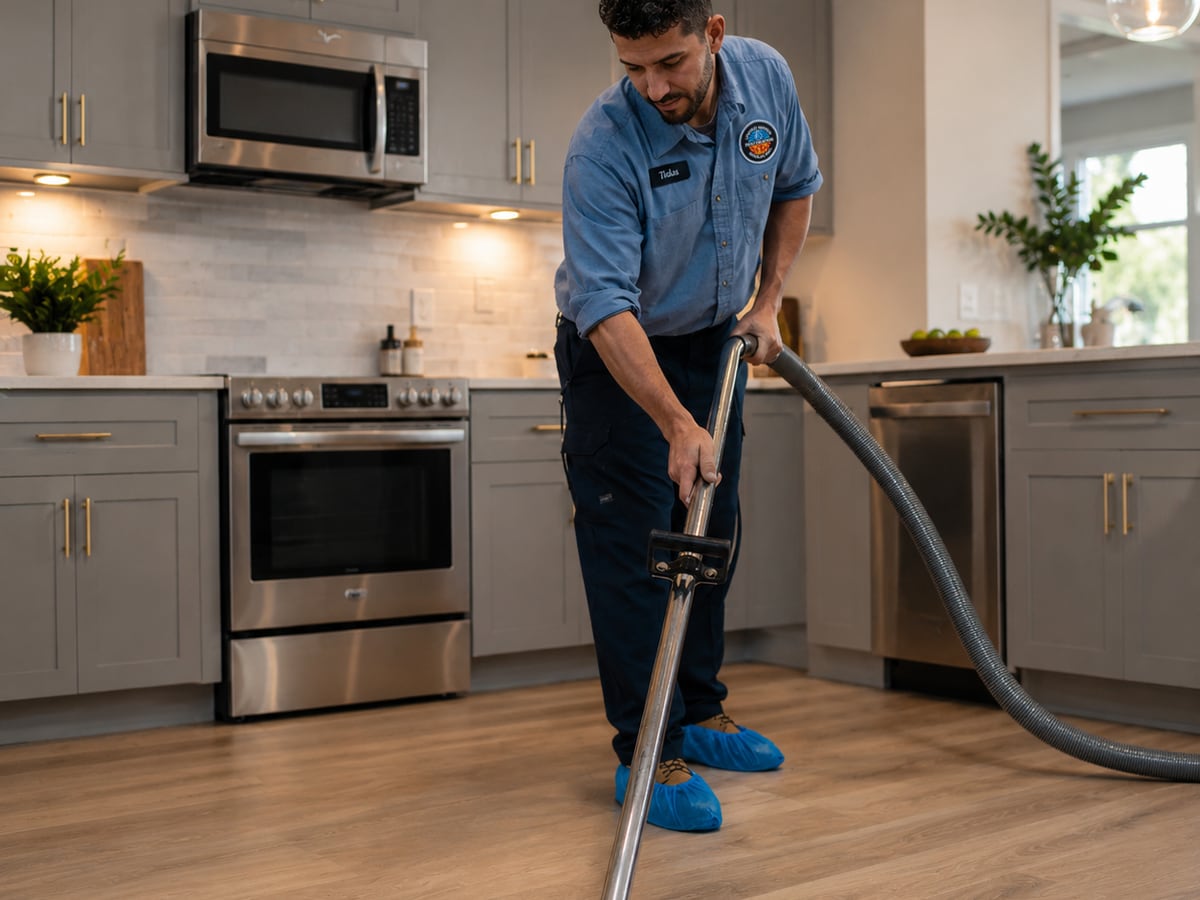
Then the standing water comes out, with extraction equipment rated for solids rather than a shop vacuum. Gross debris is bagged at the source and carried out through the clean path, not through the kitchen.
While that is happening, somebody is mapping the water. Sewage does not stay where you can see it. It runs under the toe kick of the cabinets, under vinyl plank, along the bottom plate of a wall, and through the gap where a partition meets the slab. Moisture meters and a thermal camera find the edges; we mark them on the wall in pencil so the homeowner can see exactly what we are calling affected and what we are not. Photographs, meter readings and a sketch of the spread get recorded the same day.
That record matters later. An adjuster who arrives after the drywall is already in a dumpster has nothing to look at but your word, and the difference between water that entered at the roof and water that came up through a drain decides who owns the claim. We document for that reason, and we hand you copies.
What has to leave the house, and what usually stays
The hardest conversation on a sewage job is about cabinets and flooring, so here is the honest version. Porous material that absorbed Category 3 water is removed. Carpet and pad, laminate, most engineered wood, particleboard cabinet boxes and vanity bases, upholstered furniture that wicked water up its legs, mattresses, and insulation inside a wet wall cavity. Drywall gets cut above the water line — a flood cut — because the paper face and the cavity behind it both hold contamination that a surface reading will never show. Baseboard comes off with it.
Now the better news, and in Pinellas there is usually some. Non-porous and semi-porous materials can be cleaned and kept: concrete block, the slab, ceramic tile, solid wood cabinet face frames in many cases, glass, metal and sealed finishes.
Terrazzo is the local example worth knowing about. The county's biggest building decades were the 1950s through the 1970s, and terrazzo was the floor of choice in Florida tract homes from the 1950s into the early 1970s — poured across the whole footprint and ground smooth before the partition walls went up. That has two consequences on a sewage job. Water moves room to room underneath the walls, so the affected area is almost always larger than the room the backup started in. But the terrazzo itself is essentially non-porous. Where carpet or vinyl was laid over it, the covering and its adhesive come up, and the floor underneath is usually salvageable — in plenty of Largo and St. Petersburg houses, worth more than what was glued on top of it.
Contents get sorted item by item, not by the box. Hard goods clean up. Documents, photographs and textiles are evaluated separately. Anything we recommend discarding gets photographed and listed before it leaves the house.
Clean it, then disinfect it, then dry it, in that order
Order matters here and it gets reversed all the time. Disinfectant sprayed onto soil does very little; it binds to the organic material instead of the organisms underneath. So the sequence is remove, then clean, then apply an antimicrobial. Physical removal of the contamination does most of the work. Surfaces get detergent-scrubbed and wiped, not misted and walked away from — block walls, the slab, framing, the underside of cabinet runs, the bottom plate, and every surface the water reached plus a margin above it. Only then does an EPA-registered antimicrobial go on, applied to the label, for the contact time the label says.
Drying comes last, and in Pinellas it is the part that takes patience. A concrete block wall does not dry like a frame wall. The drywall hangs on furring strips, so there is a narrow cavity between the board and the block, and the block itself holds water and keeps feeding it back. S500 calls that kind of material a specialty drying situation — low-permeance, slow to release — and it needs directed airflow into the cavity, not a couple of fans pointed at a room.
Outdoor air is no help. Relative humidity in this area averages about 74 percent year-round and never falls below a 69 percent monthly average, so opening the windows adds moisture rather than removing it. Dehumidification does the work, and it runs until the readings say it is done, not until the schedule says so. We take moisture readings daily and leave you the log.
If mold entered the picture — and Florida's licensing law attaches to mold work above ten square feet — the target is the one IICRC S520 sets: return the affected area to Condition 1, the normal fungal ecology of that building, verified afterward rather than assumed.
Why a sewage backup travels further in a Pinellas house
There is no basement to lose here, which people sometimes assume is good news. It is not, particularly. A backup in a house with a lower level goes down and stays down; on a Pinellas slab it spreads sideways, across the living space, into the rooms people actually use. Slab-on-grade has been near-universal in this county since the 1950s, the median Pinellas home was built in 1976, and 86.8 percent of the county's housing predates 2000.
The second factor is the water table. The flatwoods soils under most of developed Pinellas — Myakka, Immokalee, EauGallie — carry a seasonal high water table within six to eighteen inches of the surface for one to several months in a normal year. Saturated ground has nowhere to put more water, and neither do the drains. Nearly two-thirds of St. Petersburg's 53.62 inches of annual rain falls in four months, June through September, and July alone brings 9.73 inches. It arrives as short, violent downpours off the sea breeze rather than as drizzle. When groundwater is already high and several inches land in an hour, sanitary lines take on water they were never sized for, and the overflow finds the lowest opening in the system — often a shower drain or a floor drain inside somebody's house.
Pinellas Park is the clearest local example: flat, low, squeezed between the Gulf and Tampa Bay, with a flooding history the city documents itself and a network of drainage canals built specifically to manage it. Joe's Creek drains that area, 9.8 miles of it, through Lealman, Kenneth City, Pinellas Park and St. Petersburg.
The last factor is density. Nearly one housing unit in five countywide sits in a building of twenty units or more, so one blocked stack in a Clearwater or St. Petersburg condominium can put sewage into several units at once, and containment has to account for shared walls and a shared hallway.